When Did Hamelin’s Children Disappear?
 Hazel Johnson
Why are there two possible dates?

⠀
If you’ve ever looked beyond the familiar Pied Piper story and into its history, the year you’re most likely to encounter is 1284.
According to the traditional account, it was in 1284 that Hamelin’s children followed the mysterious piper out of the town and disappeared.
But how certain is that date?
There are no surviving contemporary records that simply tell us what happened and when. Instead, we have to piece together the evidence that survives from later centuries.
And one particularly intriguing piece of that evidence can still be seen in Hamelin today.
A sixteenth-century monument.
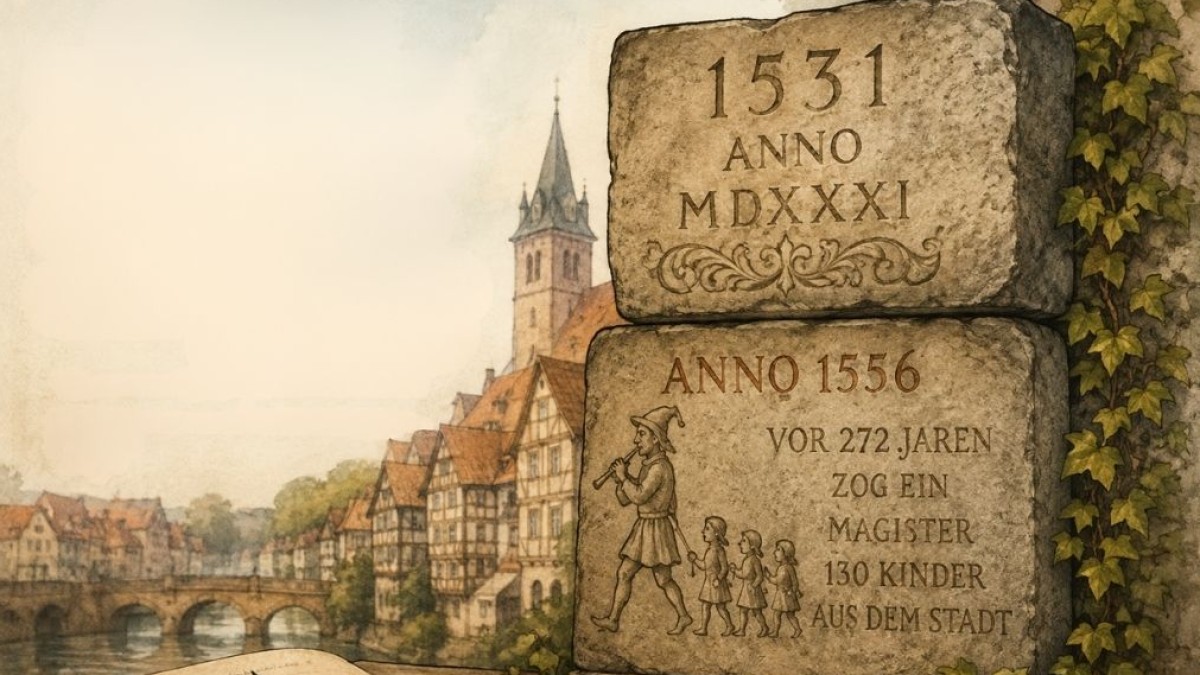
Now preserved in Museum Hameln, it originally formed part of Hamelin’s New Gate. At first glance, it appears to offer something historians would dearly love to have: a way of calculating when the children disappeared.
Except it isn’t quite as straightforward as it looks.
⠀
One monument — two stones
What appears at first to be a single stone is actually two separate pieces of stone.
The upper stone dates from 1531 and relates to the construction of the New Gate.
The lower stone was added 25 years later, in 1556. This is the one that explicitly refers to the disappearance of Hamelin’s children. Its inscription records that 272 years had passed since a magician led 130 children from the town.
And the arithmetic is wonderfully simple:
1556 − 272 = 1284.
There it is: the traditional date of the children’s disappearance.
So far, so good.
But there’s a complication.
⠀
Another date appears
In 1749, Hamelin scholar Christoph Friedrich Fein was investigating whether a real historical event might lie behind the Pied Piper story.
When Fein examined the monument, he took the 1531 date from the older, upper stone and subtracted the 272 years recorded on the later Pied Piper stone:
1531 − 272 = 1259.
Suddenly the same monument appeared to point towards two different years:
1284, if the 272 years are counted back from the 1556 stone on which they appear.
1259, if those same 272 years are counted back from the 1531 stone above it.
And that raises a question we hadn’t expected.
Why were these two separate stones joined together in the first place?
Because that could matter.
If the two stones were intended to be read together, Fein’s calculation becomes rather more interesting. If they weren’t, taking a number from one and applying it to the date on the other becomes much harder to explain.
And at the moment, we don’t know which is true.
⠀
That’s what we’re investigating
Before we can decide what Fein’s calculation tells us, we need to understand the monument itself.
Why was the Pied Piper stone added beneath an older stone that had already been there for 25 years? What relationship, if any, was intended between them?
There may be a perfectly straightforward explanation.
We just haven’t found it yet.
And that’s exactly the sort of question the Research Journal is here to explore. We’re sharing the investigation as it happens — including those moments when one question unexpectedly leads to another.
So this particular monument hasn’t finished telling its story yet.
We’ll be coming back to it.
If you’d like to know what we discover, keep an eye out here in Investigations. As soon as we know more, we’ll share it here.
⠀
Hazel
The Hamelin Project
First published 30th August 2026
⠀
Sources mentioned in this article
These are the sources discussed or used in this journal entry in the order in which they appear.
Translated titles are provided in parentheses for convenience.
- Museum Hameln, The Stone from the New Gate, permanent exhibition. Museum Hameln – The Stone from the New Gate
- Christoph Friedrich Fein, Die entlarvte Fabel vom Ausgange der Hämelschen Kinder (The Unmasked Fable of the Departure of the Hamelin Children), 1749, pp. 10–12.
⠀
The Hamelin Project Research Journal documents the ongoing process of researching the history behind the Pied Piper of Hamelin through original sources, archival research, translations, and historical scholarship.
Categories: : ❓ Questions & Myths