Where Did the Pied Piper's Children Disappear?
 Hazel Johnson

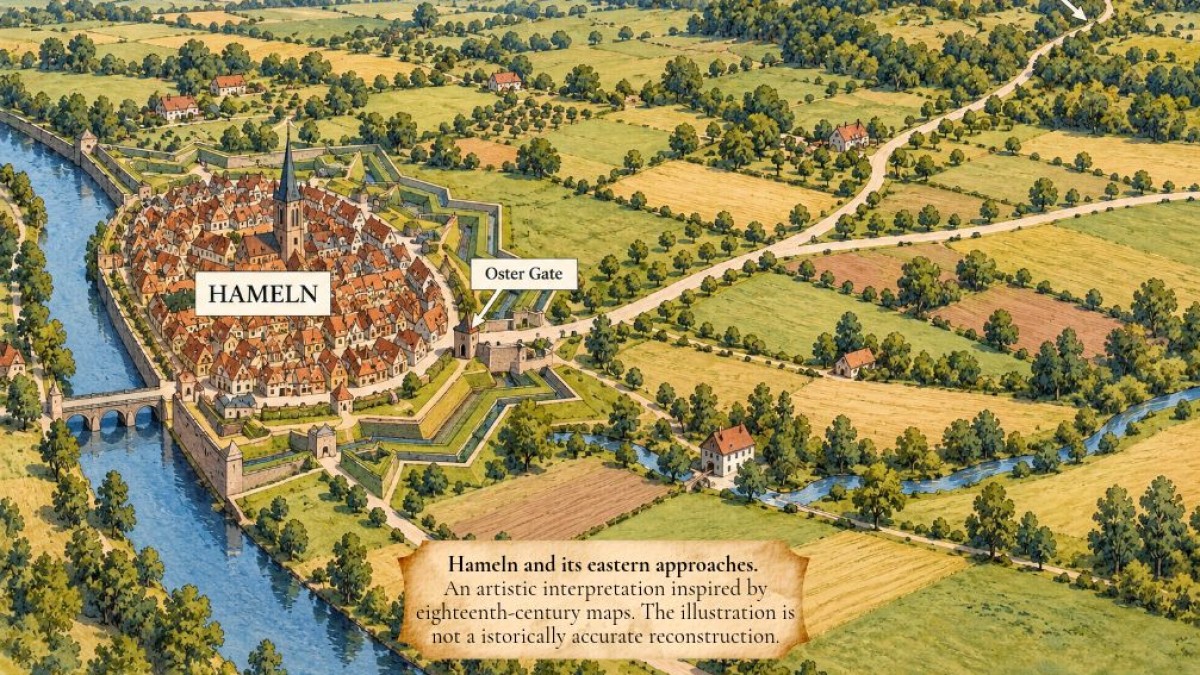
Where is that famous mountain that swallowed them up?

Picture the scene.
It's 1284, and a mysterious piper is leading the children of Hamelin out of town.
They follow him towards a hill or mountain. And then, according to the familiar story, they disappear.
But where exactly did they go?
If you visited Hamelin today, could you follow the same route? Could you find the hill where the children were said to have vanished?
You might think that somewhere so important to the story would be easy to identify.
Except it isn't.
And recently, while investigating an eighteenth-century attempt to explain the children's disappearance, we found ourselves searching for a hill that might help us understand why.
⠀
A hill called the Koppenberg
In 1749, a scholar named Christoph Friedrich Fein published an investigation into the Pied Piper legend.
Fein believed the story might have originated in a real historical event involving armed townspeople who left Hamelin and became caught up in a military conflict.
It was a very different explanation from the familiar story of a mysterious piper and 130 missing children.
But Fein's account contained something intriguing...
A remarkably detailed description of the countryside outside Hamelin.
According to Fein, a road leading towards Sedemünde left the town through the Oster Gate and divided between the gardens. One branch passed between two hills, the Galgenberg and the Koppenberg. The other crossed the Koppenberg itself. The roads then rejoined farther on.
And Fein added a particularly interesting detail...
Travellers heading towards Springe, he explained, disappeared from sight once they passed over the small rise of the Koppenberg, close to the town. Not disappeared mysteriously - simply disappeared from view.
Fein used this observation to support his theory about how the departure of armed townspeople might eventually have become a story about vanished children.
But was the Koppenberg a real place? And if so, where was it?
⠀
Searching the old maps
We decided to investigate.
We began with historical maps of Hamelin, including a town plan from around 1700 and maps of the surrounding countryside from the eighteenth century.
The earliest plan identified the Oster Gate, so at least we had somewhere to start.
But finding the Koppenberg was another matter. There were roads, fields and hills to examine, and we initially concentrated on the countryside farther away from the town.
Then something occurred to us... maybe we were looking too far away!
Fein hadn't described a distant mountain. He'd said the roads divided between gardens just outside the Oster Gate. And he'd called the Koppenberg a small rise close to the town.
Perhaps the hill we were looking for was much nearer Hamelin than we'd imagined!
We returned to the maps and looked again at the area immediately outside the old town. There were roads and junctions worth investigating. One map even named the Great and Little Oster Fields, which we surmised might have possibly been the town fields Fein mentioned.
But the maps didn't identify the Koppenberg. Nor could we establish exactly where his two roads divided and rejoined.
So, frustratingly, we still couldn't put a pin in the map.
⠀
But were we looking for the right hill?
And this is where we have to be careful.
Finding Fein's Koppenberg wouldn't necessarily tell us where the children disappeared in the original legend.
Fein was trying to explain the story through a proposed historical event. His route concerned armed townspeople travelling towards a supposed military encounter, not a documented procession of children following a piper.
His theory might help us understand how an eighteenth-century scholar interpreted the legend. It doesn't establish what happened in 1284.
⠀
So what have we discovered?
✦ We can identify the Oster Gate on a historical plan.
✦ We have a clearer idea of the landscape Fein was describing.
✦ And we've realised that the small hill he mentioned may have been much closer to the town than we'd initially been searching.
But we still haven't identified it with confidence. And even if we do, another question will remain...
Was the place where Fein imagined his townspeople disappearing from sight ever the same place where Hamelin's children were said to have vanished?
Or have we been following two quite different stories?
⠀
Hazel
The Hamelin Project
First published 23rd October 2026
⠀
Keep exploring
The investigation doesn't end here.
How do we know 130 children disappeared from Hamelin? →
We know the number. But can we discover where it came from?
⠀⠀
⠀
⠀
Sources mentioned in this article
These are the historical sources discussed or used in this journal entry, in the order in which they appear.
- Christoph Friedrich Fein, Die entlarvte Fabel vom Ausgange der Hämelschen Kinder (1749), pp. 8–9. Read the original publication
- Stadtarchiv Hameln, fortification plan, c. 1700, 600 A Nr. 8. The plan's key identifies the Oster Gate (Osterthor). View the map record
- Henning A. Nicolai, Situations Plan von der Gegend um Hameln, not before 1761. Herzog August Bibliothek. View the map record
- Kurhannoversche Landesaufnahme, sheet 131, Hameln (1773). Niedersächsisches Landesarchiv, NLA ST Karten Mappen, Mappe Nr. 0372/2, Bl. 030. View the archive record
⠀
The Hamelin Project Research Journal documents the ongoing process of researching the history behind the Pied Piper of Hamelin through original sources, archival research, translations, and historical scholarship.